

Indeterminazione en
From "Physics, Waves, Music": a website about the physics of waves and sound, acoustics of musical instruments, musical scales, harmony and music.
| AI-translated from Italian. Original page: Indeterminazione |
On the page devoted to Fourier's theorem, we learned how a periodic function can be seen as the superposition of sinusoidal functions with frequencies equal to, or multiples of, that of the periodic oscillation under examination. This result provides a mathematical apparatus that describes every type of periodic oscillation existing in nature by means of the simpler harmonic oscillations. But, as often happens, the mathematical model "idealises" natural phenomena to make them easier to describe: in this case the idealisation lies in the very concept of periodicity. A wave can be perfectly periodic only if it extends infinitely in time. This feature is ill-suited to describing a real wave, which in general always has
- a limited extent in space,
- a time evolution, in the sense that it is born (we say it has a switch-on transient), propagates and "decays" (we say it has a switch-off transient).
Why extend Fourier's theorem
Fortunately, many real waves can be considered almost periodic provided that
- their extent in space is sufficiently large (the relevant criterion is that the extent of the wave "photographed" at a given instant is much greater than the wavelength of the wave itself)
- their duration in time is much longer than the period of oscillation of the wave itself.
In any case Fourier's theorem, whose statement for periodic functions we recall for convenience,
| any continuous and bounded periodic function with period or, which is the same, with frequency , can be represented by a sum of pure sine (or cosine) functions of suitable amplitude and with frequencies that are multiples of the fundamental frequency . |


can also be extended to non-periodic functions. The key to this extension does not lie so much in using fundamental oscillations of a new type for the synthesis of the non-periodic function (the basic building blocks will remain sinusoidal functions), as in the possibility of using sinusoidal functions of any frequency, freeing ourselves from the condition of having to use only multiples of the fundamental frequency.
To understand how this extension solves the problem of representing non-periodic functions, we illustrate two simple experiments which, showing Fourier's theorem at work in two suitably chosen particular situations, suggest precisely that we should weaken the condition on the frequencies in order to synthesise non-periodic functions as well.
Frequency-time uncertainty
|
The first numerical experiment illustrates the relation between the duration of a signal in real space and the width of its spectrum (often called bandwidth). We start from a pure signal of frequency and unit amplitude
It corresponds to an infinite pure sinusoid in the time domain, while its spectrum consists of a single line of unit amplitude at frequency . Ideally the line has zero width. To make it easier to see, we widen it a little in the drawings. |
|


|
Now we build a signal by adding, in the way suggested by Fourier's theorem, n pure components of the same amplitude at integer multiples of We display the result graphically as n varies in the animation alongside. As the number of components n increases we observe that:
We deduce that there is a relation of the type where is the bandwidth, while is the width of the signal peak. The experiment therefore shows that a periodic signal requires, for its reconstruction in terms of harmonics, a bandwidth inversely proportional to the duration of its peaks. This property is of particular interest for telecommunications, where each "channel" is identified by a precise frequency band. In the limit, when we add infinitely many components, we find ourselves in a case diametrically opposite to the one we started from: we will have a signal of infinite bandwidth, corresponding to a single "needle" peak in the time domain. Acoustically this signal corresponds to a very short "click", and it is typical of percussion (see in particular snare drum, and other percussion). |





Towards non-periodic signals
|
In the second experiment we want to try a different situation: we study a signal of given bandwidth (to fix ideas, say from 0 to 10 Hz), and we study what happens when the spectral components within this band are made denser. So we build the sequence of signals ... n. Note that the signals are still added according to the prescription of Fourier's theorem, that is, all the frequencies are multiples of a fundamental frequency which, however, when n harmonics are added, is now We display the result graphically as n varies in the animation alongside. As the number of components n increases we observe that:
|

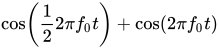




Increasing the number of lines to infinity, still without changing the bandwidth, that is, passing to a continuous set of frequencies, we obtain a single isolated non-periodic peak, since its period has become infinite. We therefore deduce, in the spirit of what we set out to do, that the extension of Fourier's theorem to a continuum of frequencies is suitable for describing non-periodic signals as well.
How does the extension of Fourier's theorem "work"?
The previous examples should have convinced the reader of the link between the spatial localisation and the time duration of a non-periodic wave (wave packet) and its construction in terms of sinusoids of arbitrary frequency.
The "golden" rule that has emerged is the following: the more the wave disturbance is concentrated in a small region of space, or the shorter its duration in time, the greater the number of sinusoids that contribute significantly to the synthesis of the disturbance itself (if you want to carry out yourself an experiment of synthesis of a periodic signal of very short time extent, visit our virtual laboratory. On this page you will find the instructions for carrying out this experiment)
This fact has important consequences:
- it is impossible for the sound emitted by a musical instrument (even if one knew how to suppress the higher harmonics) to be a pure tone, that is, one containing a single frequency f0. The limited duration of the sound means that, for its reconstruction, sinusoids with frequencies centred on the frequency f0 are needed; the width Δf of this "window" of frequencies is larger the shorter the duration Δt of the emitted sound; formally, as already said, the relation holds
- The previous relation implies that musical instruments that emit sounds of an "impulsive" character (that is, with the sound energy emitted in a very short time) such as percussion, or in any case of very short duration (think of certain virtuoso scales on the harpsichord, or of the rapidly decaying pizzicato of violins), are affected by a certain "imprecision" of pitch due to the widening of the frequency range of the spectrum [1]
- when the sound phenomenon is not emitted by a source able to select its frequency f0 (a musical instrument), but is simply due to a very rapid local change in sound pressure (for example a small explosion, or a "single-clap" applause), the wave generated contains harmonics of practically all frequencies. This aspect is used to test, over a wide spectrum of frequencies, the acoustic characteristics of a room, assessing the reflecting power of its walls (if you want to learn more about this, visit the page on architectural acoustics).
- ↑ Obviously, to the "objective" uncertainty introduced by indeterminacy in assessing the frequency of many sounds, we must add further limitations introduced by our auditory system (inertia, promptness of response, ability to discriminate frequencies, etc.) These aspects are discussed in more depth on the pages physiology of the auditory system and timbre perception
