

Domande generali en
From "Physics, Waves, Music": a website about the physics of waves and sound, acoustics of musical instruments, musical scales, harmony and music.
| AI-translated from Italian. Original page: Domande_generali |
What is the difference between sound and noise?
- Short but somewhat simplistic answer: sound is characterised by a wave that is periodic in time, noise by an irregular, disordered wave.
- The real answer is long, because the concepts of sound and noise depend not only on the objective features of the perceived sound wave, but also on the perceiving subject. That is, they depend on the interaction between the wave and the perceptual system that picks them up, transforms them and analyses them. Any answer that points to a single physical parameter characterising the wave independently of the perceptual system is hopelessly imprecise.
- For a fuller explanation, with sound examples, diagrams and a dialogue on the subject, see the pages sound or noise?, different types of noise and perception of pitch.
- See the section general features of sound for an introduction to the subject, and the section from sounds to music for the relation between noise and sound in music.
Why do we talk about the principle of wave superposition and not the law of wave superposition?
"Superposition" is the physical property of waves that corresponds mathematically to the algebraic sum of wave functions. For example, given two sea waves ψ1 and ψ2, their algebraic sum is a third wave ψ3, whose height is given, point by point, by the sum of the heights of the two waves above the water surface.
- .

So far we have used no physical law and no physical principle. We have only built a wave mathematically starting from two other waves.
Now let us turn to physics, which tells us that the motion of a wave obeys a certain physical law: the wave equation. This means that both the wave ψ1 and the wave ψ2 satisfy the wave equation. For simplicity, let us write this as:


What can we conclude about the wave ψ3: will it also satisfy the wave equation, or does it remain a mathematical object with no connection to physics?
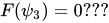
In reality the answer is: it depends. It depends on the type of waves, on the regime in which they superpose, on the possible interactions between the waves, and so on. Which means we might be forced to use different wave equations in different circumstances.
Reality is complicated, but the human brain loves simple and powerful models, so physicists immediately identified the simplest case, which is also the most common one, in which the wave produced by superposing two waves is still a wave.

In short, if this assumption holds, given ψ1 and ψ2, ψ3 will also behave as a wave and, conversely, given ψ3, we can always break it down into a combination of ψ1 and ψ2.
Powerful, isn't it?
However, since this is not a law of nature but an assumption, which must be verified or falsified case by case, we speak of a physical principle and not of a physical law.
- See also what is a wave, superposition principle, how is a wave described?, mathematical description of waves.
- For a less elementary treatment, see wave equation and related pages.
I have read that the superposition of two sine sound waves in phase opposition generates silence (the two waves "cancel each other out"). Well, then where does the energy of each wave go?
- The question is a fair one: energy cannot disappear. The answer is that complete cancellation everywhere and at every instant never happens: the energy is redistributed in space or in time, or it is not emitted at all, or it goes back.
- Redistribution in space. Two sources emitting waves of the same frequency produce an interference pattern: at some points the interference is destructive (silence), at others constructive. At the points of constructive interference the amplitudes add up and, since the intensity is proportional to the square of the amplitude, the intensity there is four times that of a single wave, not two. Averaged over all space, the intensity is exactly the sum of those of the two waves: the energy missing at the points of silence is found, in excess, at the points of reinforcement.
- Redistribution in time. Two equal and opposite pulses travelling in opposite directions along a string cancel each other at the instant they overlap: the string is perfectly straight. But it is not at rest: at that instant the parts of the string involved move with twice the velocity, and all the energy has become kinetic energy. Immediately afterwards the two pulses reappear and continue on their way (see superposition principle). Something similar happens in standing waves: at the nodes the string never moves, but the energy has not disappeared; it is at the antinodes, where it continuously changes from potential to kinetic.
- Energy not emitted. If two sources very close to each other (compared with the wavelength) vibrate in phase opposition, their waves cancel almost everywhere. In this case each source, when it compresses the air, finds next to it the rarefaction produced by the other: the air offers it very little resistance, and the two sources give the medium much less energy than they would on their own. The energy therefore stays in the generator (for example in the amplifier driving two loudspeakers connected in antiphase). This is also why a loudspeaker without a cabinet sounds weak at low frequencies: the waves emitted by the two faces of the cone are in phase opposition and cancel each other.
- Energy reflected. In the Quincke tube the sound splits into two branches that then rejoin: when the two paths differ by half a wavelength, no sound reaches the output. The energy does not disappear: it goes back towards the source as a reflected wave.
If sound is a wave, is it possible to build acoustic "lenses" or "mirrors"?
Certainly! Typical examples of both devices can be seen in concert halls designed specifically for good acoustics. In these halls an optimal reverberation must be achieved, allowing the audience, even in very large halls, to enjoy unamplified music produced by instruments or voices without compromising its intelligibility. Mirrors and deflectors (which are nothing but smooth, rigid wooden panels of various shapes) are placed where the sound needs to be deflected or diffused so as to reach listeners in all positions as uniformly as possible. Sound-absorbing panels (those perforated panels of porous material that absorb sound instead of reflecting it) have the opposite effect. They are used to damp unwanted reverberation and resonances, for example in cinemas, where the power of the loudspeakers is considerable compared with the volume of the hall.

|

|
| The Kammermusiksaal of the Berlin Philharmonie. The building was designed with particular attention to acoustics, as the official home of the Berliner Philharmoniker. Right above the area reserved for the orchestra you can see large, slightly curved panels resembling sails, which reflect the sound as uniformly as possible into the surrounding space. Note that the audience sits all around the orchestra without any substantial difference in how its sound is perceived. On the right, a detail of the sails. | |
Apart from curved acoustic mirrors (typically the set of panels placed behind an ensemble performing in a theatre), which, precisely because they are curved, act like lenses, acoustic lenses proper consist of layers of shaped materials in which sound changes its propagation speed, as happens in optical lenses. They are used especially in the sensors and signal generators of SONAR, to concentrate and amplify the signal. In ultrasound transducers too, used for example in medicine for ultrasound scans, matching layers (and a gel) are used to match the acoustic impedance of the probe to that of the human body, which is mostly water, while an acoustic lens on the probe focuses the beam.
Does sound always propagate in a straight line?
- The answer is no, for all types of waves. The propagation of a wave depends on the characteristics of the medium in which it propagates; in particular, it is straighter the more homogeneous the medium is in the region of space where the wave propagates.
- In a homogeneous medium (that is, without obstacles and with properties that do not change from one point of space to another), sound waves, like light waves, propagate in straight lines; but in the presence of obstacles, or of changes in density or other properties of the medium, the wavefronts can bend. In the first case the phenomenon is called "diffraction", in the second "refraction".
- Light waves have wavelengths of the order of half a thousandth of a millimetre, so very small obstacles are needed to see these deviations from straight-line propagation (see the section diffraction). Audible sound waves, on the other hand, have wavelengths of the order of a metre, so their interaction with practically all everyday objects distorts the wavefronts. Clear evidence of this is the ability of sound to get around obstacles such as people, cars and sometimes buildings.
- See also the sections diffraction and diffraction of sound, refraction and refraction of sound.
You can also check these phenomena for yourself interactively in the virtual laboratory. Follow the instructions on the pages Virtual laboratory: experiments on refraction and Virtual laboratory: diffraction experiments.
Do sound "mirages", like optical mirages, exist?
- Yes. Both kinds of mirage occur when waves (sound or light) propagate along curved paths in a place where we would expect them to propagate in straight lines, such as a large open space.
- In a broader sense, a mirage is an optical illusion, and here too the parallel holds, since there are acoustic illusions
- For a general description of the bending of rays, see the section on refraction, and experiment in the interactive laboratory following the instructions on the page mirages and other strange phenomena.
- For the specific case of sound mirages, and the conditions in which they can occur, see the section refraction of sound.
- To listen to various acoustic illusions see the pages acoustic effects and illusions, critical bands,
Why does lightning create the sound of thunder?
As we know, lightning is an intense electrical discharge passing through the atmosphere. A very large potential difference produces a discharge that ionises the air it passes through, instantly turning it into an incandescent plasma at a temperature of tens of thousands of degrees Celsius. This produces a very rapid expansion, and consequently a shock wave that propagates into the surrounding air. The pressure level of this shock wave easily reaches 120 dB, and can therefore cause permanent damage to the ear. However, its energy is quickly dissipated, and at some distance the shock wave turns into a true sound wave, which is perceived as the sound of thunder.
Why is it that when lightning strikes nearby we hear a sharp sound but when it strikes far away, the sound is not just weaker but also longer and blurred?
- As explained in the answer on the origin of thunder, thunder is initially a shock wave, not a sound wave. The difference is that in a shock wave the properties of the medium (such as the pressure) change abruptly (discontinuously) across the wavefront. The noise of explosions or a supersonic "bang" have similar characteristics. Close by, therefore, the ear is subjected to a strong stress in a very short time, and perceives the noise only at the instant the wavefront passes. At some distance, however, the energy of the front tends to disperse (see dispersion) and spread out in space. The wavefront becomes smoother and more continuous, and the energy reaches the ear over a longer time. This is why the corresponding noise sounds less "sharp".
- In places with obstacles (as when a storm breaks out in a valley), the reflections (see reflection) of the wave from the obstacles also help to blur the sound of thunder, creating secondary waves that reach the ear later than the direct wave.
- A final remark: distant thunder also sounds much "duller" (a kind of rumble). This means that it consists only of low-frequency waves which, along the way, are absorbed by the air much less than those of higher frequencies (on this point see power of a sound source)
