

Effetto Doppler en
From "Physics, Waves, Music": a website about the physics of waves and sound, acoustics of musical instruments, musical scales, harmony and music.
| AI-translated from Italian. Original page: Effetto_Doppler |
General remarks on the Doppler effect
Everyone has experienced the change in frequency of a sound produced by an approaching or receding source (e.g. the siren of an ambulance). Or perhaps you have heard of the discovery of the expansion of the universe thanks to the "red shift" (that is, the shift towards red of the light emitted by galaxies), or of the "supersonic bang" of jet aircraft. Or again, you may know a diagnostic technique called echo-Doppler for examining the state of blood vessels. These very different phenomena can, however, all be traced back to an effect discovered by the Austrian physicist Doppler, which consists in the change of frequency of a wave "perceived" by an observer (listener) when there is relative motion between the source of the wave and the observer.
An instructive little story
To understand the Doppler effect we will refer to the following little story: a person A (the source) and a person B (the receiver) pass parcels to each other along a long conveyor belt moving at speed . Person A puts parcels on the belt one at a time, at a regular rate of parcels per second, so that on the belt the parcels are evenly spaced at a distance


(for example, if the belt moves at speed m/s and the number of parcels put down in one second is , then the parcels will be spaced =0.5 m apart). Clearly, in steady state, once the first parcel has reached person B, the number of parcels received by B will be exactly parcels per second.


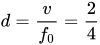
The analogy with waves is evident: the parcels represent the wavefronts, the conveyor belt represents the medium carrying the wave at a given speed , and the number of parcels received in one second is exactly the frequency of the wave .
If there is no relative motion between source and observer, the frequency perceived by O is the same as that emitted by the source S.
Moving source and stationary observer
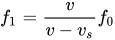
Now suppose that, to speed up the arrival of the parcels, person A, unable to change the speed of the belt, decides to move forward in the same direction as the belt with speed , while keeping the "regular rate" of parcels per second at which the belt is loaded. Clearly, the number of parcels reaching person B in one second is now greater than , since the parcels on the belt have "crowded together" and their distance has become

(1)

Since these parcels move at the speed of the belt , person B will receive a parcel every seconds. The number of parcels unloaded in one second will therefore be . Substituting the value of calculated above we obtain:


(2)
Stationary source and moving observer
Now suppose that person A cannot move, but we still want to increase the number of parcels person B receives. This can be achieved by telling person B to "come towards" the parcels at a fixed speed, say . Clearly, person B now sees the parcels, separated by a distance (person A is stationary again!!), approaching at a speed . The arrival frequency will therefore now be


(3)
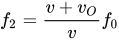
There is a surprising aspect to the story: even if person B goes towards the parcels at the same speed at which person A moved forward, that is, if , the frequencies B perceives are different. Indeed:

(4)

Why are the two cases different?
At first sight this seems to contradict Galilean relativity outright (after all, it should not matter whether Mohammed goes to the mountain or the other way round!!): two observers moving with O in the two cases (and therefore in uniform straight-line motion with respect to each other) should measure the same perceived frequency. The fact is that the equivalence of the two inertial observers fails because we have overlooked something: in the physical system in question there is a "privileged" reference frame, the one in which the medium is at rest and in which the wave travels at speed . For example, in the case of sound (which travels in still air at about 340 m/s), an observer in uniform straight-line motion could claim to be moving with respect to the privileged frame simply by measuring the speed of sound and obtaining a value different from the expected 340 m/s.
The situation is different if the propagating wave is light: one of the postulates of special relativity states that the speed of light is the same for all observers in uniform straight-line motion with respect to one another. That is, there is no single privileged reference frame in which the speed of light is the famous constant c=300,000 km/s. In this case, therefore, the two situations should be completely symmetric. It can indeed be shown that, for light, the change in frequency depends only on the relative motion of source and observer, and the relativistically correct formula is:
(5)
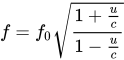
where u is the relative velocity between source and observer.
A final remark: what happens if source and observer move apart instead of approaching? Following the previous reasoning, it is easy to predict a decrease in the perceived frequency (the parcels thin out!!) and to obtain as a result
(6)
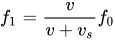
(7)
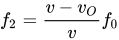
Formulas that "explode": the supersonic bang
| A question that may seem a mere mathematician's whim, but hides a surprising physical effect, is the following: what happens if the denominator of (2) becomes zero (that is, if )? Going back to the parcel example, the situation is unsettling: person A moves forward at the same speed as the parcel just put down. The second parcel will be put exactly on top of the first, and so on. Person B will receive the parcels "all at once".
If we replace:
|

it is clear that B will receive all the pressure waves at the same instant and will hear a loud "bang".
What would happen if person A even moved faster than the parcel just put on the conveyor belt? The answer is simple: the parcels would reach person B in reverse order: the last parcel put down would arrive first, and so on. If a person A moved towards a person B faster than sound (remember that the speed of sound in air is about 340 m/s) shouting AMOR, what would person B hear? The answer is of "capital" importance, but we have no intention of revealing it.
A more common experience is the "boom" produced by a jet aircraft breaking the sound barrier (see also what is the loudest possible sound that can be produced?)
Virtual laboratory: experiments on the Doppler effect
By connecting to our 2D Waves virtual laboratory you can see for yourself the crowding and thinning of wavefronts and the phenomenon of the "supersonic bang"
Suggested experiments:
Further reading and links
- As explained on the page reflection of sound, the Doppler effect is the basis of many diagnostic devices (you may have heard of echo-Doppler).
- Visit also the questions and answers section to find out more about the Doppler effect in "extreme" conditions.
- On the page on electromagnetic waves you will find a spectacular consequence of the Doppler effect: the "red shift" of galaxies.
