

Rifrazione nelle corde en
From "Physics, Waves, Music": a website about the physics of waves and sound, acoustics of musical instruments, musical scales, harmony and music.
| AI-translated from Italian. Original page: Rifrazione_nelle_corde |
- When a wave passes from one medium into another in which its propagation speed changes, interesting phenomena occur at the boundary surface between the two media: the wave seems to "split". One part is reflected back into the first medium, while another can enter the second medium, but its characteristics (amplitude, speed, direction of propagation, wavelength) differ from those of the incident wave.
- Here we want to investigate the relations between the incident wave and the two waves produced, which we will call reflected (the one going back into the first medium) and refracted (the one entering the second medium). To examine the simplest possible case, we study the phenomenon in a single dimension.
Refraction of waves in a string

- Consider two pieces of string of different density joined end to end. Let us make a small effort of abstraction and imagine that both strings are ideal, and that the joint is an equally ideal weld. This effort is rewarded by the fact that all the calculations are simpler under these assumptions. For example, we can say that the tension T is the same along the whole resulting composite string.
- Waves move at different speeds in the two strings taken separately: indeed (see wave equation in a string, natural frequencies of a string and speed of mechanical waves), calling ρ1 and ρ2 the respective densities, we have
;


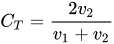
Now consider a wave travelling along the composite string from the type 1 section towards the type 2 section. It will cross the first section with speed v1 but, on reaching the discontinuity (the joint between the two strings), the wave is partly reflected and partly transmitted. Which fraction of the incident wave is reflected and which fraction is transmitted is given by two numerical coefficients, called the transmission coefficient and the reflection coefficient, whose calculation is the subject of a separate section (transmission and reflection). They are
, (5)
. (6)
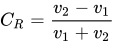
Now, to grasp the meaning of the coefficients, let us visualise various cases:
| propagation | comment | |||
|---|---|---|---|---|

|
The pulse travels much more slowly in string 2 than in string 1. We can say, with negligible error, that it does not propagate at all in the second string or, equivalently, that string 2 has infinite impedance. The incident wave is almost completely reflected with phase inversion, and the transmitted wave is practically zero. The transmission coefficient is very close to 0, while the minus sign of the reflection coefficient indicates phase inversion. | |||

|
Neither the reflected nor the transmitted wave is zero. The reflected wave has the opposite phase to the incident wave and a smaller amplitude. The energy of the incident wave is shared between the reflected and the transmitted wave. | |||
|
|
As in the previous case, but the transmitted wave is larger. A larger part of the energy passes from string 1 to string 2. | |||

|
The two strings have the same density, so in reality they are the same string. Since there is no discontinuity, the pulse travels undisturbed. The reflected wave vanishes, and the energy flows freely from left to right. The reflection coefficient is therefore zero, while the transmission coefficient equals 1. | |||

|
A small reflected wave appears, with the same phase as the incident wave. The energy of the incident wave is shared between the reflected and the transmitted wave, but most of it is still transmitted. | |||

|
As in the previous case, but the reflected wave is larger. A larger part of the energy bounces off the discontinuity back towards string 1. | |||

|
The pulse travels much faster in string 2 than in string 1. We can say, with negligible error, that string 2 is infinitely "light" or, equivalently, that it has zero impedance. Having no inertia, it follows the motion of the right-hand end of string 1 immediately. The incident wave is almost completely reflected without phase inversion, and the transmitted wave involves almost the whole of string 2 simultaneously. The reflection coefficient is very close to 1. |


In the images above, for ease of visualisation, the propagation of a single (Gaussian) pulse is shown. This case does not differ from the case in which harmonic waves propagate, because waves on an ideal string all have the same speed. The case of a real string would be different: there, because of dispersion, pulses change shape as they propagate in each medium.
