

Frequenze proprie della corda en
From "Physics, Waves, Music": a website about the physics of waves and sound, acoustics of musical instruments, musical scales, harmony and music.
| AI-translated from Italian. Original page: Frequenze_proprie_della_corda |
Definitions and approximations
By ideal string, in this context, we mean a one-dimensional, perfectly flexible object.
The parameters describing an ideal string are summarised in the following table:
| symbol | meaning | SI unit |
|---|---|---|
| L | length of the string | m |
| T | tension of the string | N |
| μ | linear density of the string | kg m-1 |
When studying the physics of real objects, we must find conditions that approximate the ideal ones.
- An object much longer than its diameter approximates the condition of one-dimensionality, provided that the motion of the string about its axis (torsion) can be neglected.
- The condition that the string is perfectly flexible can reasonably be assumed if the stiffness (that is, the shear stresses) and all external forces are negligible compared with the tension.
- Moreover, the tension is assumed not to change much during the motion of the string, that is, not to depend on either the amplitude or the frequency of the oscillation. These conditions are generally met only for small displacements from equilibrium, and for frequencies that are "not too high".
When a real string departs from these conditions, the results given here of course do not hold, and more complex models are needed (anharmonic corrections).
Transverse vibrations of the ideal string fixed at both ends
The fundamental frequency of an ideal string fixed at both ends is given by
- .
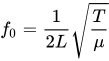
The higher frequencies are integer multiples of its fundamental frequency f0
- .

How are these values calculated?
We can follow two equivalent routes:
- solve the wave equation with the boundary conditions describing the string fixed at both ends, namely that the displacement of the string is zero at the ends (see wave equation)
- study the normal modes of the string (see normal modes and normal modes of a string)
Natural frequencies of the string in the presence of friction
In the section wave equation we briefly described the wave equation in the presence of friction, and its general travelling solution. Here we are interested in the stationary solutions, whose frequencies correspond to the natural frequencies of the string. Calling γ the friction coefficient, we get
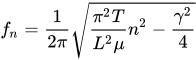
Note that, for the same mode (the integer n), the frequency with friction is slightly lower than that of the string without friction.
