Equazione delle onde nella corda en
From "Physics, Waves, Music": a website about the physics of waves and sound, acoustics of musical instruments, musical scales, harmony and music.
| AI-translated from Italian. Original page: Equazione_delle_onde_nella_corda |
The ordinary equation
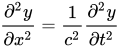
Consider an ideal string of length L, lying along the x axis and free to oscillate transversely in the y direction. The linear equation of the oscillations is
- ,
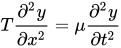
where is the linear density of the string, and its tension.


This equation is nothing but Newton's ordinary equation of motion
- ,

only specialised for a continuous system such as the string.
How it is derived
The equation is derived as follows:
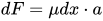
- consider an infinitesimal segment of the string while it is oscillating. Let dx be its length. Its mass is consequently .
- For this small segment we want to write the equation of motion in the direction, perpendicular to the length of the string: .
- The balance of forces is simple, because only the tension force acts at the ends of the small segment considered. The particular assumptions that make the string ideal have in fact these consequences:
- T is constant during the motion of the string (that is, whatever its deformation)
- T has the same magnitude along the whole string, and, at every point, acts only in the direction tangent to the string (that is, without components perpendicular to the string).
- all other external forces (such as gravity) are negligible compared with T.


|
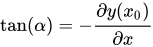
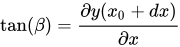
The balance of the forces acting in the y direction on the segment gives (see figure):
Remembering that we actually want to study a segment of string of infinitesimal length dx, we can approximate with , and, remembering that the tangent to the curve y(x) is nothing but its first derivative with respect to x, write
and finally, replacing the infinitesimal difference of the first derivatives with the second derivative we obtain
|

|






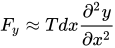
- The motion of the string is only transverse, so the acceleration of the string is only along the y axis. The right-hand side of Newton's equation (mass times acceleration) is then written
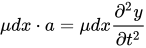
Equating the two sides obtained above gives the equation of motion quoted at the beginning.
All right, but what does it mean?
| A simple dimensional analysis shows that the term
has the dimensions of the square of a velocity. Indeed, writing the wave equation for the string as
we see that the numerators have the same dimensions, and the denominator on the left has the dimensions of the square of a length; therefore the denominator on the right must also have dimensions equal to the square of a length. The constant c is important because it is precisely the speed at which waves propagate in the string. In our ideal case it is the speed at which all waves propagate in the string. This is shown by observing that any function of the form
where and are arbitrary functions, is a solution of our wave equation. But is nothing but an that moves in time at a constant speed c. How it is solved
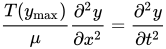
"Less ideal" stringsIn real strings the wave equation in general no longer has the form described above. Let us see how it changes if we drop, one at a time, the assumptions we made for the ideal case. Dropping assumption no. 1T is constant during the motion of the string (that is, whatever its deformation) In real strings the tension T depends on the shape of the string itself, or at least on the maximum displacement of the string from its equilibrium position. Assumption no. 1 is almost always valid as long as the maximum displacement of the string is not very large. In mathematical terms, dropping this ideal assumption means making T a function of (more generally a functional of y(x))
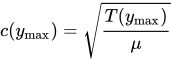
Consequently, without ideal assumption no. 1, the speed of waves in the string is no longer a constant, but depends on the shape of the string itself, or at least on the size of its deformation.
This implies that for large displacements waves travel at a different speed than for small displacements.
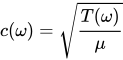
In this case the phase velocity and the group velocity of the waves in the string differ. That is, high-frequency waves propagate at a different speed from low-frequency waves. (Remember that, for sound waves, higher frequencies generally correspond to higher-pitched sounds) Dropping assumption no. 2Part one: T has the same magnitude along the whole string... This assumption is actually rather well justified if the string is homogeneous. The case of non-homogeneous strings is not of particular interest for musical instruments, or for oscillations, while it has important applications in signal transmission along electrical lines, and in transduction (see for example impedance, reflection in strings, refraction in one dimension (in Italian)). Part two:...at every point, acts only in the direction tangent to the string (that is, without components perpendicular to the string). Considering transverse components of the tension in the string means thinking of the string no longer as a one-dimensional system, but as a genuine three-dimensional system. Think, for example, not of a violin string but of a thick steel cable of a suspension bridge. Then we cannot neglect, for example, its torsional motion, which can take energy away from the transverse vibration modes, modifying them. See the section on waves in bars Dropping assumption no. 3all other external forces (such as gravity) are negligible compared with T. If we include other forces in the equation, then the behaviour of the string depends on the nature of these forces. In particular, it is straightforward to introduce friction forces that tend to damp the oscillations, and also external forces that keep the string vibrating by counteracting friction. These terms can easily be included in the wave equation while keeping it linear (e.g. we know that the friction term leads to the telegraph equation: see wave equation).
For waves described by a nonlinear equation, the superposition principle no longer holds: two waves that "collide" along this string can influence each other! In this regime one observes an interesting variety of phenomena, some of which, although not specific to strings, are examined in the pages Nonlinear effects, Fermi-Pasta-Ulam chain, Intermodulation distortion and Modulational instability |