

Interferenza tra onde riflesse en
From "Physics, Waves, Music": a website about the physics of waves and sound, acoustics of musical instruments, musical scales, harmony and music.
| AI-translated from Italian. Original page: Interferenza_tra_onde_riflesse |
Interference between waves reflected from the end of a string
We have already seen in the section reflection in strings that when a single pulse reaches the end of a string, it is reflected by it. The way it is reflected differs depending on whether
- the end of the string is fixed (that is, unable to move);
- the end of the string can move freely.
| Reflection from a fixed end | Reflection from a free end |
|---|---|

|

|
If, instead of a single pulse, a periodic succession of pulses is sent towards the ends (that is, ultimately, a periodic wave, for example a harmonic one), the reflected pulses can interfere with the incoming pulses, leading to the formation of points called nodes, where there is destructive interference. Even without using the mathematical apparatus developed in the section mathematical aspects of interference, it is easy to determine geometrically the position at which the node nearest to the end of the string forms. To this end, look at the following animations; in them you can observe the dynamics of reflection when a harmonic wave is in steady state (that is, all the nodes have already formed). Keep in mind that:
- the wave moving to the right (in red) is the incident (progressive) wave
- the wave moving to the left (in green) is the reflected (regressive) wave; its phase is inverted (or not) depending on whether the reflection is caused by the fixed end or by the free end;
- the total wave formed by the superposition of the incident and reflected waves is shown in black; it is the so-called standing wave;
- in the standing wave, particular positions of the string are highlighted (black points) where the superposition of the waves is always destructive (nodes).
| Reflection from a fixed end | Reflection from a free end |
|---|---|

|

|
From the analysis of the sequence of images some conclusions can be drawn at once:
- the node nearest to the end forms, in the case of the fixed end, at a distance from the end equal to
(1)

- and in the case of the free end at a distance
(2)

- once the position of the node nearest to the end of the string has been established with formulas (1) and (2), all the other nodes will be found at distances equal to multiples of half a wavelength. Let us see why: to this end it is enough to observe that the incident and reflected waves approach each other with a relative speed twice that of the single travelling wave. The maximum and the minimum of the two waves meet again after travelling only half a wavelength. The following image may clarify the situation further:

Ultimately, armed with the two previous observations, we can determine all the positions of the nodes from the end (fixed or free); calling the distance from the end of the string, the nodes will be found at the positions

- for the fixed end
with (3)
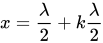

N.B. The value has been added to account for the formation of the node at the fixed end. Condition (3) is equivalent, setting , to


with (4)

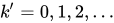
- for the free end
with (5)
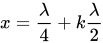

Note that the formation of nodes occurs whatever the wavelength of the travelling wave; in the phenomenon of reflection from a single end there is no selection mechanism for wavelengths.
Interference between waves reflected from both ends of a string
In the previous example it is taken for granted that there is a source S (not visible) that generates, without interruption, the succession of pulses travelling to the right. In a much more realistic situation, the source S could be the left end of the string. For this end, too, the conditions on the position of the nodes (4) and (5) must hold, which arise from the interference between the waves it reflects and the waves incident on it. The finite length L of the string now makes it impossible to satisfy these conditions for every value of the wavelength. Looking at the following figures, in which the distances of the nearest node from the ends are imposed according to rules (1) and (2)

- string with both ends fixed
it is evident that the following relation must hold between the wavelength λ and the length L of the string
with (5')


- string with both ends free
- with

which, changing variable, can also be written as
with (6')

- string with one free end and one fixed end
with (7')
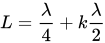
Quantisation conditions (selection of wavelengths)
The constraint imposed by the finite length of the string has produced a wavelength selection mechanism: the wavelengths must now satisfy the three conditions (5'), (6'), (7'). Deriving the wavelengths from these conditions we obtain the quantisation conditions
| type of constraint | "allowed" wavelengths |
|---|---|
| fixed ends | with |
| free ends | with |
| one fixed end and one free end | with |


Further reading and links
- This page is of fundamental importance because it clarifies the mechanism by which oscillating elements of finite extent (strings) satisfying given boundary conditions (free or fixed ends) select certain wavelengths. On the page reflection of sound you will see that such selective mechanisms also arise when what vibrates is a suitably shaped column of air.
- The selection of wavelengths is of fundamental importance for understanding how musical instruments generate notes of a definite pitch. If you want to understand how this happens, visit the page standing waves and the remarks on frequency on the page on reflection in strings.
- If you want to see a collection of animations of standing waves, visit the section normal modes of a string
