

Estensione degli strumenti musicali en
From "Physics, Waves, Music": a website about the physics of waves and sound, acoustics of musical instruments, musical scales, harmony and music.
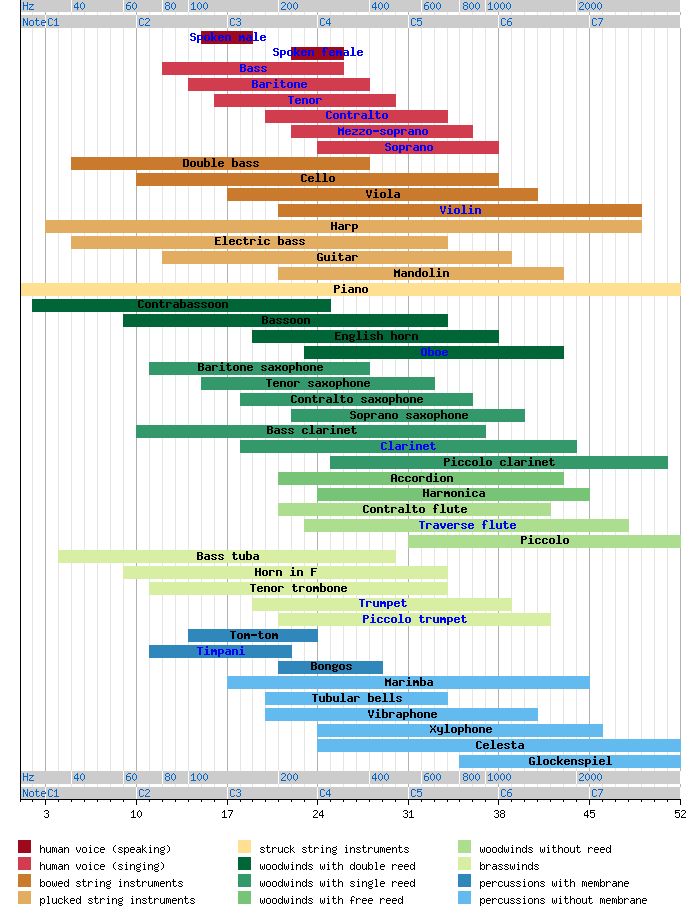
- The following table presents the approximate range of several modern musical instruments. Obviously, each instrument does not produce a pure tone but a wide spectrum of harmonic sounds that are different for each note.
- The range illustrated in the table refers to the fundamental produced by the instruments and not the entire spectrum. If we consider the entire spectrum, we can observe that the highest harmonics produced by almost all the instruments (including voices) easily reach the limit of the audible range.
- This explains why high fidelity in audio recording and reproduction can only be obtained by using an appropriate bandwidth (up to about 20000 Hz); i.e. in the case of digital sound, a sampling frequency of at least 40000 Hz: according to the sampling theorem, the signal must be sampled at least at twice the highest frequency to be reproduced (CDs use 44100 Hz).
- We can also clearly see that the human voice is significantly distorted during transmission over a telephone line, which usually has a bandwidth of about 3000 Hz (from 300 to 3400 Hz). And yet on the telephone we easily recognise the pitch of a male voice, whose fundamental (about 100-150 Hz) is cut off: the brain reconstructs it from the harmonics that get through (this is the effect of the missing fundamental).
Check your understanding
Which instrument in the table has the widest range, and between which frequencies?
Answer. The piano: from A0 at 27.5 Hz to C8 at about 4186 Hz, more than seven octaves.The fundamentals of instruments do not exceed 4-5 kHz. Why, then, does a high-fidelity recording need a bandwidth up to about 20000 Hz?
Answer. Because every note also contains harmonics, which reach the limit of the audible range: cutting them would change the timbre. For a digital signal up to 20000 Hz you must sample at least at 40000 Hz.The telephone transmits only frequencies between about 300 and 3400 Hz. Does a male voice with its fundamental at 120 Hz arrive with the right pitch?
Answer. Yes: the fundamental does not get through, but the harmonics do (360, 480, 600 Hz and so on), 120 Hz apart, and from these the brain reconstructs the pitch of the missing fundamental. The timbre, however, is altered.
Categories:
