

Energia trasportata dall'onda en
From "Physics, Waves, Music": a website about the physics of waves and sound, acoustics of musical instruments, musical scales, harmony and music.
| AI-translated from Italian. Original page: Energia_trasportata_dall'onda |
If we recall the definition of a wave as a disturbance that propagates (see what is a wave), we can ask which physical quantities propagate together with the disturbance itself. The answer, of course, is not unique, because it depends on the particular type of disturbance we consider in each case. For example, a mechanical wave propagates a deformation, an electromagnetic wave propagates the variation of the electric and magnetic fields, a "Mexican wave", besides the fans' enthusiasm, propagates the variation of their height, and so on.
We know, however (see also the discussion of the speed of mechanical waves), that all waves arise when, together with a disturbance, a medium shows
- restoring forces that oppose the formation of the disturbance itself and tend to bring the medium locally back to equilibrium.
- a certain inertia, which instead tends to keep the disturbance in its state of motion.
To fix ideas, let us see what happens in the case of mechanical waves
Energy in purely mechanical waves
When mechanical waves propagate in a medium, the disturbance is always a local deformation of the medium. The restoring forces are known as elastic forces, and the inertia corresponds to the local mass of the medium, more commonly called density.
Once a deformation has occurred, for example because of an external force, a portion of the medium is out of equilibrium, so an elastic force pulls it back towards its initial position. When, however, the portion of the medium is back in its initial position, its inertia makes it tend to continue its motion, so that it soon finds itself out of equilibrium in the direction opposite to the initial deformation. Elastic forces in the opposite direction to the first pull it back again, and this whole cycle repeats, giving rise to a local oscillation that can be transmitted to the neighbouring elements.
In a continuous medium the deformation can be an elongation, a compression, etc.; in a medium made of many discrete components (see coupled oscillators) the deformation is instead the displacement of each oscillator from its equilibrium position.
What we want to stress here is that the existence of restoring forces together with displacements from equilibrium can produce work, quantified by the product of the component of the forces in the direction of the displacement and the displacement itself.

But in physics the capacity to do work is called energy
The example of the elastic string
If we imagine a string carrying a transverse wave, we can distinguish two types of energy:
- kinetic energy, which is the energy each portion of the string has because of its transverse oscillation velocity.
- potential energy, which is the energy due to the elastic deformation of the string.
- During the oscillatory motion these two energies are alternately transformed into each other.
But beware: the string is not a point mass, but a continuous body. This means that these two energies are not concentrated at a precise point, but are distributed along the whole string. So calculating them is not as simple as for a point mass (see harmonic oscillator).
The locally relevant quantity is not the total energy, but the energy per unit length, or energy density. Unlike the total energy, which is conserved throughout the motion, the energy density can vary locally with time. It can move from one point of the string to another. Indeed, precisely this quantity moves together with the wave travelling along the string, and at the same speed.
At every point of the string
- The potential energy density is at a maximum when the string element is at the position of maximum deformation compatible with the constraints at that point.
- The kinetic energy density is at a maximum when the string element has its maximum velocity.
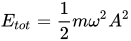
To simplify further, imagine that the string oscillates in harmonic motion. The total energy (that is, the sum of the kinetic and potential energy) of a harmonic oscillator of mass m oscillating at angular frequency with amplitude A is easy to calculate[1], and is

- .
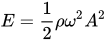
However, we said that, in the case of the string, which is a continuum of oscillators with mass per unit length (density) , we are interested not so much in the energy as in the energy per unit length (energy density). This is

- .
We also said that this density travels at the speed c at which the wave propagates along the string. So the final quantity we are interested in is the product of the energy density and the speed
, (1)
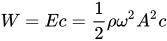
which has the dimensions of a power (watts), and gives exactly the energy flux, that is, the amount of energy carried by the wave that passes a given point of the string per unit time.
If we think of the equivalent quantity in a three-dimensional situation, rather than on our one-dimensional string, the quantity becomes a vector, measured in W/m2. It gives the amount of energy flowing through unit area in a given direction per unit time.
The concept applies to all forms of energy, and is particularly suited to describing the radiation of energy, whether light, sound, etc. Very often, since the energy flux is caused by waves, its average over a given period of time is measured, and the resulting quantity is called the intensity of the field producing the flux. This is, for example, the physical definition of sound intensity. For more details, however, see the discussion of the perception of loudness, which distinguishes the physical term from the everyday term intensity of a sound (in Italian the same word is used for both), which refers to the perceived quantity, something quite different from this one.
Link between energy and impedance of the string
In many contexts it is useful to consider the concept of impedance, meaning, in the simplest case, the proportionality constant between the force applied to a portion of the string and the resulting transverse velocity of the oscillation.
Calculating this quantity, usually denoted by the letter Z, is not difficult (see impedance of a vibrating string), and gives
- .

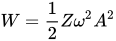
So, substituting into (1), we immediately see that the energy flux in the string can be written as
(2)
Further reading and links
- To discover various contexts in which the problem of energy transmission arises, see also the pages reflection, refraction in one dimension (in Italian), impedance matching, transmission and reflection coefficients, standing waves.
- ↑ See the section on mechanical energy in harmonic motion
