

Come si descrive un'onda? en
From "Physics, Waves, Music": a website about the physics of waves and sound, acoustics of musical instruments, musical scales, harmony and music.
| AI-translated from Italian. Original page: Come_si_descrive_un'onda? |

A complete description of a wave is complex for two kinds of reasons:
- a wave is a phenomenon that is extended in space and variable in time;
- there is a great variety of waves, which differ both in the nature of "what oscillates" and in "the way it does so" (think of transverse and longitudinal waves).
The problem can be overcome by separating, in the description of the wave, these two sources of complexity. This can be done by introducing a mathematical function , called the wave function, depending on time and space, which on the one hand describes mathematically the quantity that is oscillating; on the other hand, the physical interpretation and the units of vary depending on the nature of the wave itself.

- Some examples:
| type of wave | quantity described by the wave function |
|---|---|
| electromagnetic waves | electric field, or magnetic field |
| sea waves | water level with respect to the calm sea |
| sound waves | pressure (or displacement) of the air with respect to still air |
| elastic waves | deformation of the medium |
Note: the wave function contains direct information on the quantity that oscillates, not on the medium that may carry the oscillation. For example, for sea waves, describes the profile of the surface, but contains no direct information about the water. However, studying the propagation of waves in a medium often provides information about the nature of the medium. For example:
- measuring the change of direction of a light wave when it passes from air to glass tells us the value of the refractive index of glass relative to that of air (see the section refraction).
- observing how a wave is reflected or transmitted at the interface between two different substances shows directly how much the substances oppose the transmission of energy by the wave itself (see the section refraction in one dimension, in Italian)
- measuring the properties of seismic waves, such as amplitude, direction of oscillation and arrival times at the seismograph, not only shows where the epicentre of an earthquake is, but can give valuable information about the internal structure of the Earth (see the section speed of mechanical waves).
- most properties of matter at the molecular or atomic level are measured by irradiating a sample with waves (usually electromagnetic, such as visible light, ultraviolet light, X-rays, rays, but also beams of electrons or neutrons) and observing the response of the sample

Travelling waves (pulses) that propagate without changing shape
To become familiar with the use and properties of the wave function, let us examine a very simple case: a single pulse propagating along a string without changing shape. In this case the physical interpretation of the wave function is the vertical displacement (in the y direction) of the string with respect to its undisturbed position.
It is instructive to approach this case from two different points of view which, in the end, will of course turn out to be equivalent as far as the properties of the wave function are concerned.
The point of view of the travelling pulse
Let us start with travelling waves, that is, essentially, pulses which, generated by a source, are free to travel indefinitely in the medium at a certain constant speed v without becoming deformed.
|
As an example of such travelling waves, imagine a string whose left-hand point (which we call S, for source, shown in red in the animation alongside) is forced to move in the y direction, perpendicular to the string, according to a certain time law . Note that the first coordinate indicates that the source is at the point x=0. We ask what the time law will be for the motion of the points of the string at a distance x from the source. One of these points is highlighted in blue in the animation. |
|


We denote this time law by . Suppose, as we said, that the disturbance induced at the source S propagates to the right with speed v and that, neglecting dissipative phenomena, each point of the string reproduces exactly the motion of the source with a certain delay time, which depends both on the speed of the wave and on the position x of the point. It is easy to see that this delay time is given by


and that the function is given by

- the first law expresses the fact that, for times shorter than the delay time, the disturbance has not yet reached the point with coordinate x;
- the second law shows that the motion of the source is reproduced at the point with coordinate x with a certain delay, which depends on the distance of that point from the source S.
Let us clarify the situation with a numerical example: if, at this instant, the source has been oscillating for a time seconds and the delay time at a certain point of the string is 3 seconds, that point has been oscillating for only 2 seconds. The two variables x and t entering the wave function are not independent: using the definition of delay time we can state that


that is, introducing the variable p (a function of the point P and of the observation time t), which has the dimensions of a time,

we obtain

which shows that the wave function can be seen as a function of the single variable p=p(x,t), a function of the point P.
The point of view of the photographed pulse
We can approach the same physical situation as in the previous section by reasoning as follows:
|
|

|

|


Now, if the second photograph is nothing but a translation of the first, that is, a shift along the x axis without any change in the shape of the function, we must have
- .

The function has stayed the same, but its profile has shifted to the right along the x axis by an amount

- If we know that the speed of translation is v, then we can relate the shift of the profile in space () to the time elapsed between the two photographs ()
- ,

and, consequently, we can obtain the expression of the wave function for any time we like:
- .

that is, introducing the variable p* (a function of the point P and of the observation time t), which has the dimensions of a distance,

we obtain

which shows that the wave function can be seen as a function of the single variable , a function of the point P.
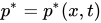
Note that the variables p and are related by

(1)

A direct calculation easily shows that
(2)

if
.

(2) gives a remarkable illustration of the phrase often found in textbooks: "Going forward in space is like going back in time". Beyond the mathematical proof given by (2), the meaning of the phrase becomes clear as soon as we consider that visiting parts of the string farther from the source, that is, going forward in space by an amount , is equivalent to going back in time by seconds, in the sense that the delay needed to reach the position farther from the source increases.
Periodic waves
Frequency is measured in hertz (number of oscillations per second). |

|




If, as we said, the disturbance of the source (the green point), periodic in this case, propagates to the left with speed v (the red arrow), the wave will move with a "shape" that follows exactly the source (if we exclude dissipative phenomena that slowly damp the amplitude of the wave). The following two images help introduce the physical parameters that characterise the description of waves. The two images are very similar, but with some important differences:

|

|
|
|


Note the link between the two graphs: when the wave in the first graph has moved to the left by an amount v·Δt, the of the source has the value indicated by the tip of the green arrow. This is what is shown in the second graph.
The link between wavelength and period is evident if we recall the relation valid for motion at constant speed:
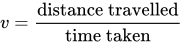
from which it is easy to deduce that
- .

where in the second equality we have used the inverse proportionality between period and frequency.
We thus obtain the following fundamental result:
In a periodic wave travelling at constant speed, wavelength and frequency are inversely proportional
Frequency and wavelength completely characterise the physical description of periodic waves, and for this reason they provide an effective way of classifying waves of the same nature (think of electromagnetic waves or sound waves).
Further reading and links
- A special case of periodic waves is the one in which the time law is sinusoidal. These waves are extremely important and have many remarkable properties. For this reason the section harmonic waves is devoted to them.
- To make it easier to identify the physical quantities that determine the description of a wave, we have chosen to follow, in its journey through space and time, the pulse generated by a single source. It is interesting to ask, when several sources are present (for example, the two ends of the string could oscillate independently, each with its own time law), what happens to a point of the string that is reached at a given moment by pulses coming from different sources. The answer to this question is fundamental for understanding how waves "interact" when they occupy the same region of space; you will find extensive explanations on the page on the superposition principle.
- A further simplification in the description of waves was introduced when we "postulated" that waves propagate without changing their shape. This assumption is clearly unrealistic for two reasons:
- the first is, so to speak, "energetic" (the wave must gradually lose amplitude because of internal friction occurring during the oscillations of the medium);
- the second, much more subtle, is due to a phenomenon called dispersion. Visit the relevant page to clarify this aspect.
- After so many formulas, we suggest you visit our 2D Waves virtual laboratory, where you can observe wave phenomena in all their complexity. In the phenomena you observe, try above all to grasp the regularities, and to understand how the physical quantities introduced on this page arise naturally from the need to describe these regularities quantitatively.
