

Approfondimenti sulle guide d'onda en
From "Physics, Waves, Music": a website about the physics of waves and sound, acoustics of musical instruments, musical scales, harmony and music.
| AI-translated from Italian. Original page: Approfondimenti_sulle_guide_d'onda |
Description of the ideal system

Imagine a pair of metal plates as in the figure.
Suppose we want to send electromagnetic radiation of wavelength λ into the space between the two plates.
To simplify the calculations, suppose the radiation is linearly polarised along the y direction.
Suppose the spacing between the plates is a, while in the y and z directions the system extends to infinity (in practice it is enough for the plates to be much larger than along y and z).

Recall that the magnitude k of the wave vector k is related to the wavelength of the incoming wave by
- .

In general, that is, for a wave propagating in three dimensions,
- ,
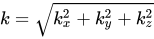
where kx, ky, kz are the Cartesian components of k. When the wave enters the guide, however, not all values of kx, ky, kz are allowed, because of the reflecting nature of the walls of the guide.
Introducing the boundary conditions
Since the electric field tangent to the surface of a conductor is always zero, along the plates, that is, for and , we must have



and, since we have chosen to deal with radiation polarised in the y direction,
- .

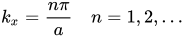
The wave is free in the y and z directions, while in the x direction it bounces back and forth between the walls, which forces this component of the wave vector to a discrete set of values, exactly as happens for the frequencies of a vibrating string:
- .
The mathematical expression of the wave propagating between the plates must therefore be that of a standing wave in the x direction and a travelling wave in the z direction
- .

Propagation speed
Let c be the speed at which the wave propagates freely in the medium between the plates. For example, for a sound wave c is the speed of sound in the medium; for an electromagnetic wave, c is the speed of light in the medium.

|
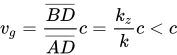
The speed at which the wave moves along the guide (that is, in the z direction) is lower than c, because the wave, while still propagating in the medium at speed c, follows a zig-zag path in the guide, bouncing back and forth between the walls. The effective propagation speed in the z direction, which is the group velocity of the wave in the guide, is
|

|
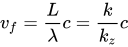
On the other hand, the drawing shows that in one period T the wavefront, which travels a distance λ in the direction of motion of the wave, covers a length L along z. This means that the wavefront moves along the guide with speed
This is, by definition, the phase velocity of the wave in the guide. Note that, since ,
In other words, for electromagnetic waves in a waveguide, the phase velocity can exceed the speed of light in vacuum. This does not contradict the theory of relativity. |


- The App Onde 2D en can be used to visualise the propagation of waves in a guide in real time, and to observe directly the various effects described on this page.
- The page virtual experiments on waveguides offers guided tours to help you use the app
Dispersion relation
In free space, that is, in the medium without the guide, the relation between ω and k, called the dispersion relation, is
- ,

where c is the speed of the waves in the medium. Note that the relation is linear.
For a wave propagating in the guide, it becomes
- .
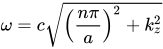
This relation is particularly interesting for several reasons:

- First of all, there are different dispersion curves for the different modes of the guide. Indeed, each mode is identified by a different value of n.
- For each n the dispersion is no longer linear.
- The dispersion approaches the linear relation of free space only for large values of , that is (since k is fixed) the more nearly parallel the original direction of the wave is to the z axis.
- Conversely, for kz small compared with k the dispersion departs from the linear case, and in particular, at the same frequency, the values of kz in the guide are smaller than those in free space. As we have already seen, this means a lower group velocity.
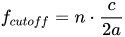
- For each mode there is a specific cutoff frequency (in the figure the cutoff frequency corresponds to the intersection of the dispersion curves with the frequency axis: we have chosen the units so that it equals 1 for the first mode, 2 for the second, and so on). As is easy to show by imposing the condition , for the n-th mode it is


- If the waves have a frequency below the cutoff frequency, there is no wave vector kz that can propagate them.
