

Impedenza dell'oscillatore armonico en
From "Physics, Waves, Music": a website about the physics of waves and sound, acoustics of musical instruments, musical scales, harmony and music.
| AI-translated from Italian. Original page: Impedenza_dell'oscillatore_armonico |
The driven harmonic oscillator
The simple harmonic oscillator is determined by the equation of free motion

which describes the motion produced by an elastic restoring force proportional to the displacement of the mass m from the origin of the coordinates. denotes the instantaneous acceleration. The law of this motion is

- ,

where

is the natural frequency of the free oscillation, while A and β are two constants that depend on the initial conditions of the motion.
Here, instead, we are interested in the driven oscillator, which is a harmonic oscillator to which, besides the elastic force, an external force is applied, also harmonic, of arbitrary frequency. The equation of motion becomes

where

is the external force.
Mechanical impedance of the oscillator
- Recall that the mechanical impedance of the system is the ratio between the force applied at a point and the velocity of that point. In the mks system it is measured in mechanical ohms (kg/s). We are generally interested in the linear frequency response of the system, which means that we study the motion of the system when we apply to it, as "input", a force of small amplitude oscillating periodically in time (in particular sinusoidally).
- The mechanical impedance of the oscillator is the ratio between the force F(t) exerted on the oscillating mass and the velocity v(t) of the mass itself.
To calculate it we assume that the resulting motion is still harmonic, and substitute into the equation of motion the trial solution
- .

We obtain the equation
- ,

from which we obtain the amplitude of the resulting motion as a function of the amplitude of the applied force and of the frequency
. (1)
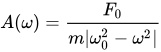
Now it is easy to obtain the velocity
- .

Note now that force and velocity are not in phase with each other. Indeed, while the force is a cosine function, the velocity is a sine function, which means that the velocity is shifted by ±90° with respect to the applied force.
So this is a striking example of the two effects of impedance, namely attenuation and phase shift. Having determined the phase shift, we can determine the attenuation by considering the ratios between the maximum values (or, more precisely, the root-mean-square values over a period) of F and v
. (2)
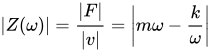
Note that at low frequencies the impedance of the oscillator is dominated by its stiffness, while inertia matters little, whereas at high frequencies the mass of the oscillator becomes the dominant feature of the motion, while stiffness has little influence. The region around where the two properties become equally important is the region in which a resonance occurs. Resonance corresponds to a minimum of the impedance, that is, to the point at which the oscillator offers the least resistance to the external force that keeps it in motion.

Remarks
Studying the amplitude of the oscillation as a function of the frequency of the external force, a few considerations become immediately apparent.
- For a fixed intensity of the external force, the amplitude of the oscillations is larger the closer the frequency of the external driving gets to the natural frequency of the oscillator.
- Frequencies much higher or much lower than tend to damp the amplitude of the oscillations. In this case we must think that the energy of the external source is discharged onto the constraints without being able to turn into work.
- For frequencies close to the energy of the external source is transferred more and more efficiently to the oscillator, accumulating from period to period and causing ever larger oscillations.
- For the oscillations become of infinite amplitude, because all the energy of the source accumulates in the oscillator in each period. In reality the system may break apart after some time (when the constraint reactions can no longer withstand the stresses), or it may reach a maximum oscillation without being destroyed (when part of the energy of the source can be dissipated in some way, for example through friction: see the next section)


|

|
Effects of friction
In the previous section we considered the oscillator subject only to the elastic restoring force and to the periodic external force F(t)=F0cos(ωt). In real situations oscillating systems are subject to dissipative phenomena (which damp the amplitude of the oscillations by dissipating energy) due to the presence of friction forces. These forces can be due
- to sliding friction (this is the case of a mass-spring system in which the mass slides on a "rough" supporting surface),
- to friction between internal parts of the oscillating system (think of the oscillation of a viscous liquid),
- to the friction that the oscillating parts of the system encounter because of the presence of a medium (this is the case of the oscillations of a pendulum or of a string, which are damped by the presence of air). This friction (due to the resistance of the medium) can often be described, at low speeds and in the absence of "turbulence" in the medium, by an expression of the type:
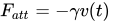
The equation of motion becomes

where, on the right-hand side, we have put the total force acting on the oscillator.
To find a solution of the new equation, we now assume a trial solution
(3)

with the aim of determining the constants A and so that (3) gives a solution of the equation of motion.

Differentiating and substituting we obtain the equation
. (4)

If we now set


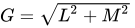
dividing both sides of (4) by G we obtain:
. (5)

Given how the numbers L, M and G have been defined, we may set

and

since the fundamental relation of trigonometry holds
- .

(5) therefore becomes:
. (6)

Recalling the well-known trigonometric formula for the cosine of the sum of two angles, we can write (6) as:
. (7)

For (7) to hold at every instant t we must have
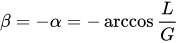

from which we obtain the solution we were looking for in the form
(8)

Now it is easy to obtain the velocity
- .

Once again force and velocity are not in phase with each other. Compared with the undamped case, the velocity is shifted by an angle equal to 90°+β(ω), which now depends on the frequency of the external force.
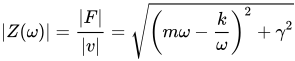
Having determined the phase shift we can, as before, determine the attenuation by considering the ratios between the maximum values (or, more precisely, the root-mean-square values over a period) of F and v. This time we obtain
. (9)
Remarks
Looking at expression (8) and comparing it with (1) we notice that the general behaviour is unchanged:
- for driving frequencies very different from the natural frequency of the oscillator, the amplitude of the oscillations remains small. As resonance is approached, the response of the oscillator becomes larger and larger. This time, however, it is not infinite at the resonance point, but reaches a maximum, determined by the friction coefficient of the system. At that point there is the maximum possible transfer of power from the external source to the oscillating system, and part of the energy is dissipated as heat through the friction forces in each period.
- If we study the response curve as a function of the friction coefficient, we naturally find that the resonance becomes larger the smaller the dissipation of energy, and this is obvious in the light of what has been said above.
- However, we also discover that the curve becomes narrower the smaller the friction. The system is more frequency-selective the less energy it loses to the environment. This is a very important observation both for classical applications such as filters and for quantum physics.
- Finally, we observe that the friction coefficient also causes a small change in the resonance frequency of the system. It is in fact
- .
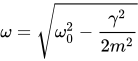
So the resonance frequency decreases as friction increases. This deviation is generally small because γ has very small numerical values compared with m and k.

|

|
