

Equazione delle onde nell'acqua en
From "Physics, Waves, Music": a website about the physics of waves and sound, acoustics of musical instruments, musical scales, harmony and music.
| AI-translated from Italian. Original page: Equazione_delle_onde_nell'acqua |
For simplicity we deal with waves in ideal water, that is, in a fluid that is
- incompressible
- inviscid.
The first approximation is very good for real water (see the discussion of the speed of mechanical waves). Mathematically it is equivalent to taking the density ρ of water as constant. The second approximation is equivalent to neglecting the effect of friction forces and, for example, rules out the formation of vortices. Mathematically it is equivalent to taking the velocity field u(x,y,z,t) as conservative, that is, there exists φ(x,y,z,t) such that
- .

Consider a body of water of depth h in which waves of wavelength propagate. Depending on the ratio between depth and wavelength, two cases are distinguished.

Long waves in shallow water (tidal waves)
These are, for example, the waves produced by the tide, for which the depth of the water is much smaller than the wavelength
- .

The only forces to consider in this case are the force of gravity and the pressure forces in the water. The motion of a small volume of water is governed by Bernoulli's equation, which expresses the conservation of mechanical energy per unit volume.
Since the water is shallow, we can neglect the vertical acceleration of its molecules, and the exact equation of motion in the vertical direction
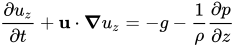
can be approximated by
- ,
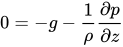
which gives Stevin's law
- ,

where ζ(x,y,t) is the height of the liquid at the point (x,y) with respect to the plane .

and substituting into the equations of horizontal motion
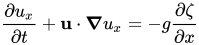
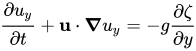
from which, noting that neither right-hand side depends on z, it follows that the molecules lying in a vertical plane at a given instant always remain aligned during the motion.
Waves in deep water (surface waves)
These are, for example, the ripples produced by the wind on the sea, or by surface tension in a container. The depth of the water is much greater than the wavelength
- .

In this case the vertical acceleration of the particles of the liquid can no longer be neglected, and the equations of motion become more complicated. Leaving out the details, we find that the propagation speed is
- ,
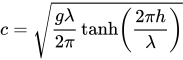
where the hyperbolic tangent function is defined as follows
- .
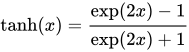
Note that, if the water is deep enough, that is, for
- ,

the hyperbolic tangent is close to 1, so the speed can be written as

That is, for example, if is expressed in metres
- .

This shows the phenomenon of dispersion for surface waves: the propagation speed of the wave depends on (the square root of) the wavelength.
