

Aspetti matematici dell'interferenza en
From "Physics, Waves, Music": a website about the physics of waves and sound, acoustics of musical instruments, musical scales, harmony and music.
| AI-translated from Italian. Original page: Aspetti_matematici_dell'interferenza |
General conditions for interference of in-phase sources
Constructive interference between point sources
Imagine we have two point sources and emitting periodic waves of the same amplitude, frequency and phase.


These waves propagate in the space around the sources and, when they reach the same point P, they superpose and interfere. We ask under which conditions the point P is a point of (totally) constructive interference. It is easy to understand that this happens when two "maxima", so to speak, reach the point P at the same instant.

This condition is met when
- (in terms of time) calling and the times the wave needs to travel the distance separating P from and , the difference between these times is a multiple of the period T of the wave, that is:


with (1)


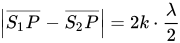
- (in terms of space) if the path difference is an even multiple of half the wavelength
(2)
with
Equation (2) can easily be deduced from equation (1), but it requires an additional hypothesis: the propagation speed of the wave must be constant. Under these conditions, multiplying equation (1) by the wave speed v we obtain


which is exactly (2), since


The additional hypothesis of a constant propagation speed may not hold if, to reach the point P, the wave has to cross different media. If this happens, as we know from the phenomenon of refraction, the speed of the wave changes. In such cases the condition for constructive interference must be obtained only in terms of equation (1) or, as we shall see, by using the concept of optical path
At the points where constructive interference occurs
- the amplitude of the oscillation doubles with respect to the amplitude of the oscillations generated by the two sources;
- the frequency of the oscillation, on the other hand, stays the same;
It is interesting to note that, depending on the frequency and type of the waves undergoing the "constructive" effect, there are interesting consequences for what an observer placed at point P actually perceives:
- in the case of monochromatic light (that is, made of electromagnetic waves of the same frequency), the intensity of the light (related to the amplitude of the oscillation) is reinforced without any change of "colour" (related to the frequency). Given the high frequency of "light" oscillations, whose period is much shorter than the persistence time of the image on the retina, the alternation of light and darkness at the point (occurring when the amplitude of the wave is zero) cannot be perceived; a continuous brightness is observed instead;
- in the case of sound, a reinforcement of the intensity of the sound (related to the amplitude of the oscillation) is heard, without any change in pitch (related to the frequency). In this case too, the frequencies of audible sounds are such that the ear cannot perceive the alternation of sound and silence (when the amplitude of the wave is zero).
- in the case of "sea waves", the low frequency of oscillation makes it possible to observe the oscillation with reinforced amplitude, with a "wave upon wave" effect (as Paolo Conte would put it).
Destructive interference between point sources
Again imagine we have two point sources and emitting periodic waves of the same amplitude, frequency and phase.
We now ask under which conditions the point P is a point of (totally) destructive interference. It is easy to understand that this happens when a maximum and a minimum reach the point simultaneously and cancel each other out when added.

This condition is met when
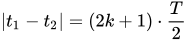
- (in terms of time) calling and the times the wave needs to travel the distance separating P from and , the difference between these times is an odd multiple of the half-period T/2 of the wave, that is:
(1*)
with
- (in terms of space) if the path difference is an odd multiple of half the wavelength
(2*)

with
In this case too, equation (2*) can be deduced from equation (1*) only under the hypothesis that the propagation speed of the wave is constant.
It is interesting to note that the "destructive" effect completely cancels the oscillation at the point P. The consequences for what an observer placed at point P perceives are evident (but no less surprising for that):
- in the case of monochromatic light (that is, made of electromagnetic waves of the same frequency), complete darkness is observed at point P.
- in the case of sound, there is silence at point P;
- in the case of sea waves, a buoy placed at point P would remain completely still as the two waves pass.
General interference conditions for out-of-phase point sources
Now imagine we have two point sources and emitting periodic waves of the same amplitude and frequency, but not synchronised. Assume, for example, that source reproduces the oscillation of source with a certain phase delay time, which we denote by . We assume

- if source oscillates behind

- if source oscillates ahead of

If we now ask under which conditions the point P is a point of constructive interference, it is easy to understand that condition (1) must be modified to account for the delay time of source . The time the wave needs to travel the distance separating P from must now be changed by (increased or decreased depending on whether the oscillation of lags behind or leads)
Equation (1) therefore becomes:
with (1**)

Equation (2) consequently becomes (still assuming a constant propagation speed of the waves):
with (2**)

The concept of optical path
|
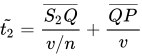
We now want to tackle the following question: how do the interference conditions change if the wave changes its propagation speed along the way from the sources and to the point P? A typical situation is that of light which, before reaching point P, may have to pass through lenses, water, etc. We tackle the question in the simple case of identical, in-phase sources and , with the geometry shown in the figure. To determine the condition for constructive interference we must now take two facts into account:
The time for the wave generated by to reach point P is now given by:
|
|



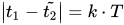
The condition for constructive interference takes the form
- in terms of time
with (1***)
- in terms of space (multiplying (1***) by v)
with (2***)
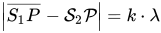
where we have defined

The length is called the optical path of the wave. Note that it no longer coincides with the length of the broken line . Its physical meaning, however, is very clear: it represents the distance the wave would travel in the time if it always travelled at speed v. The optical path is obtained from the geometric distance by "amplifying" by a factor n those stretches of the actual path (the broken line ) that the wave travels at speed v/n.

Virtual laboratory: interference experiments
If you are interested in visualising interference phenomena, connect to our 2D Waves virtual laboratory. Below we suggest a series of guided experiments, but you are free to try out new configurations and new experiments. The app is very intuitive; to understand correctly what you observe, just keep in mind that the coloured areas represent the amplitude of the oscillation. The brighter the colour, the larger the amplitude of the oscillations (green for crests, red for troughs). Of course, the dark areas represent the absence of oscillation caused by destructive interference.
Suggested experiments:
- Interference between two or more point sources of the same frequency
- Interference between two point sources of different frequencies
- Interference between waves of different frequencies generated by a single source (beats)
- Reflection from a parabolic mirror
Further reading and links
- A particularly important case of interference is that of harmonic waves. In this case the general interference conditions take a much simpler mathematical form. The page interference of harmonic waves deals with the question in general.
- On the page antennas and interference you can watch some animations illustrating how the interference of several sources of spherical waves can produce complex effective sources of practical interest in telecommunications.
- Interference can also explain how antennas work
- You can use the App Onde 2D en to visualise interactively the phenomena described on this page
- On the page virtual experiments on interference you will find a guide to some of the possible virtual experiments on interference with the 2D Waves app.
